
VirtualSpace AppSec Features
AI-assisted static analysis to find vulnerabilities in your C++, C, Python, JS, and .NET source code. VirtualSpace AppSec analyzes code you own or are authorized to review, and is built to defend, not to attack. A multi-layered approach surfaces a broad range of issues while keeping scans fast.
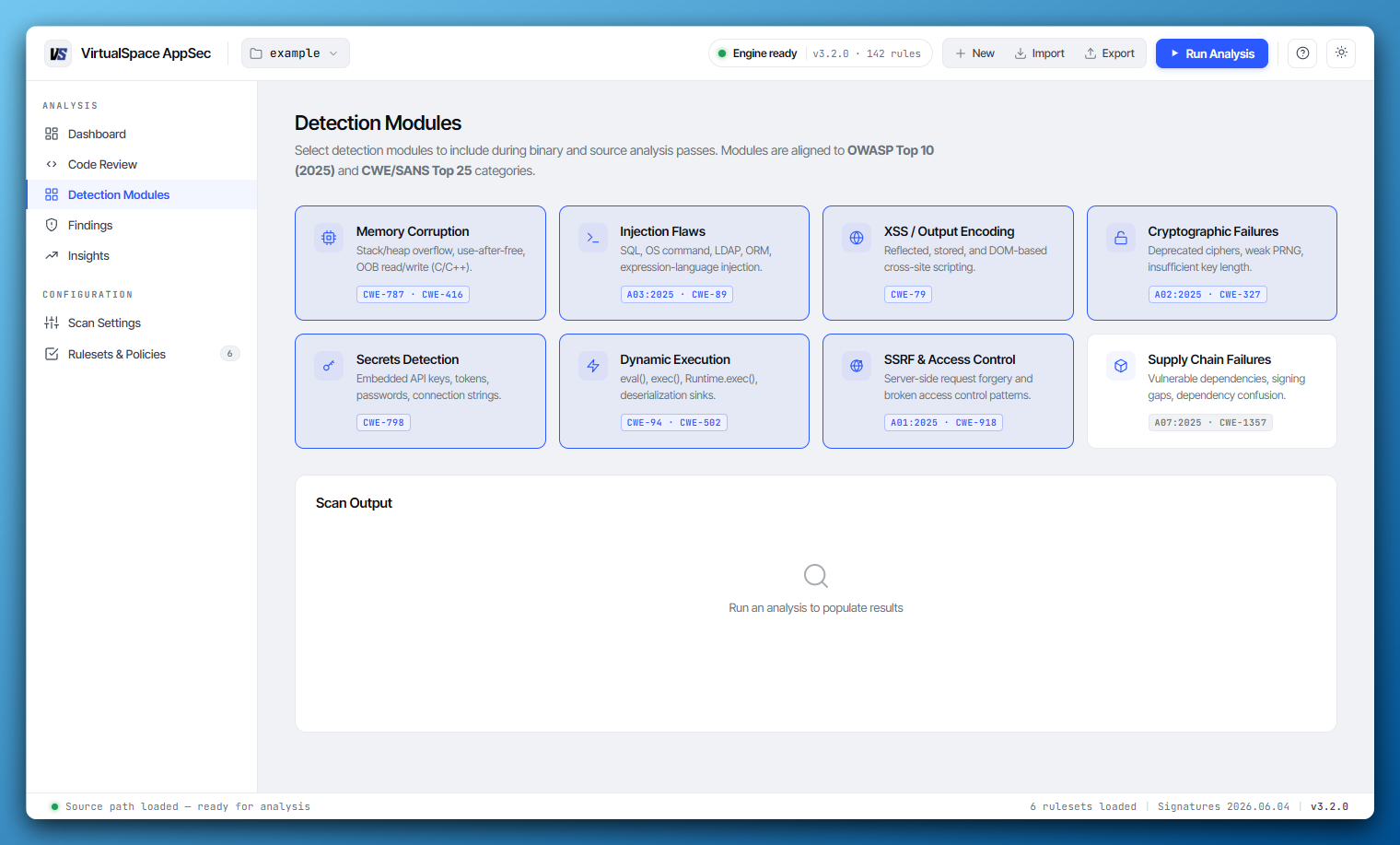
Scan Configuration Options
Configure advanced scanning parameters and sensitivity levels customized to your application's security requirements and performance constraints.
Analysis Options
- Enable heuristic analysis
- Check for CVE database matches
- Include experimental detections
- Scan embedded resources
Performance Settings
- Use multi-threading
- Low memory mode
- Cache analysis results
- Optimized scanning algorithms
Scan Depth Levels
Choose from three distinct scanning levels that balance thoroughness with analysis time. Each level provides progressively deeper examination of your application's security posture, from basic vulnerability detection to exhaustive security auditing.
Security Rule Sets
Leverage industry-standard security frameworks and compliance requirements with our comprehensive rule-based detection system. Each rule set targets specific vulnerability categories and compliance standards. You can also import community-authored rules.
OWASP Top 10 (2025)
Latest OWASP vulnerability patternsCWE / SANS Top 25
Most dangerous software weaknessesPCI DSS Compliance
Payment card industry standards safety (JS)Custom Rule Sets
Your own project-specific security policies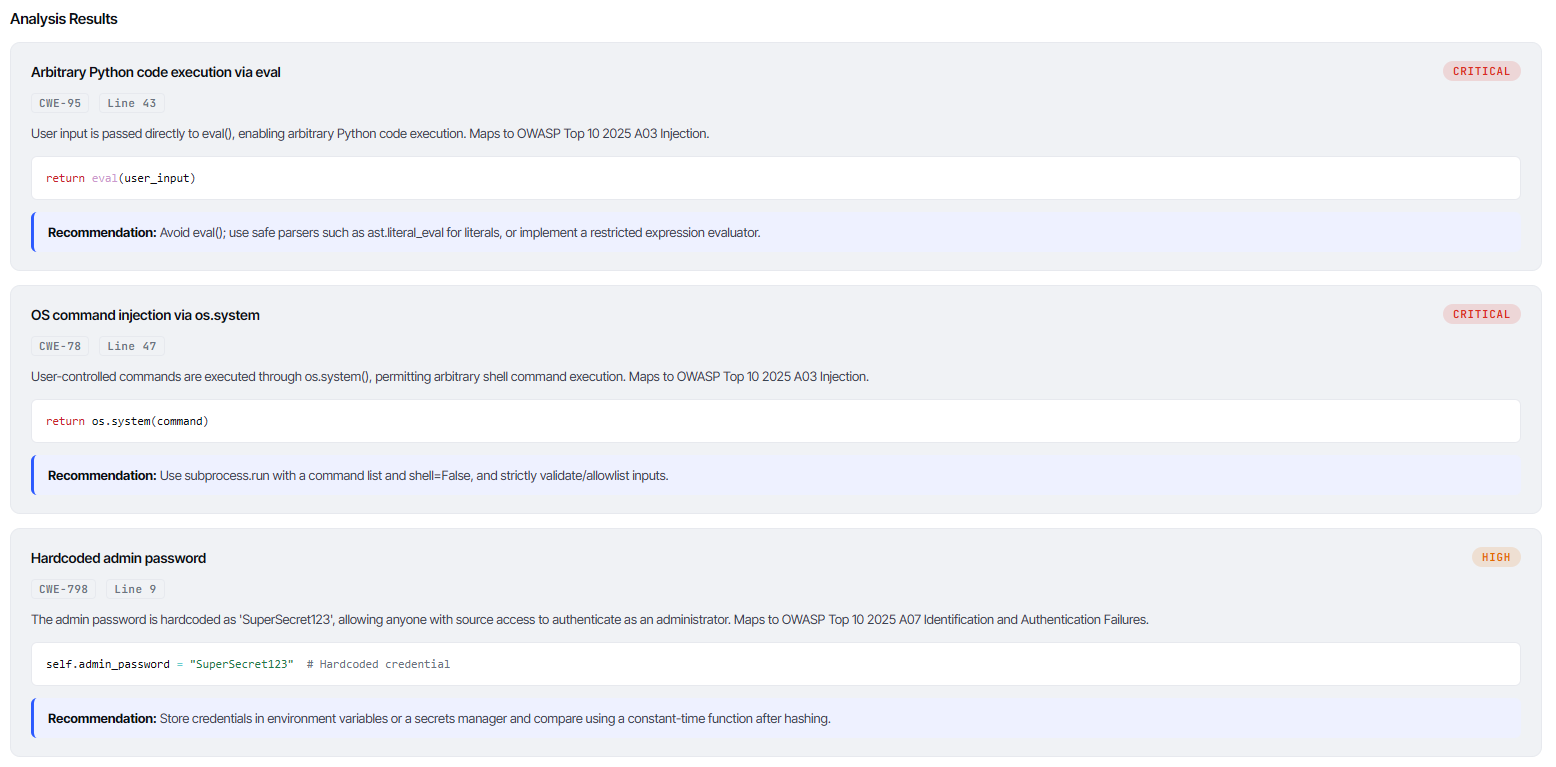
AI-Powered Vulnerability Detection
Advanced machine-learning models, trained on vulnerability classes and secure-coding patterns, analyze selected local source files inside a predefined workflow. The goal is practical, explainable vulnerability detection without giving customers access to a general-purpose AI model.
Memory Safety Analysis
- Buffer overflow detection
- Use-after-free identification
- Heap corruption detection
- Memory leak analysis
Code Quality Assessment
- Insecure function usage
- Weak cryptographic implementations
- Authentication bypass patterns
- Input validation flaws
Advanced Reporting
- Detailed vulnerability reports
- Remediation recommendations
- Executive summary generation
- Risk severity classification
Taint & Data Flow Analysis
- Source-to-sink path tracking
- Injection vulnerability detection
- Taint propagation analysis
- Unsanitized input tracing
Secrets & Configuration
- Hardcoded credential detection
- Exposed API keys & tokens
- Insecure default settings
- Sensitive data exposure
Workflow Integration
Slot VirtualSpace AppSec into your own development workflow with comprehensive reporting and automation capabilities designed for independent developers and security researchers who ship their own code, from the command line to your CI pipeline.
Reporting Features
- Export comprehensive reports
- Import previous scan results
- Custom report templates
- Compliance documentation
Platform Support
- Windows 10 / 11 compatible
- Command line interface support
- Native C / C++ source scanning
- .NET Framework analysis
Important notice: VirtualSpace AppSec is not a subscription-based service and is not a cloud service. Licenses are one-time purchases for the chosen duration and must be renewed manually if you want continued term access. VirtualSpace does not store your source code, scan output, or application data in the cloud; analysis remains on your local machine except for a limited license check. No recurring charges, and no automatic renewals.
AI framework: VirtualSpace AppSec runs within a predefined local analysis framework. The analysis engine processes selected local source projects and returns structured assessment results only. Direct interaction with the AI model is not possible, which keeps outputs consistent and the evaluation workflow controlled. Every scan is reproducible and auditable, giving you a clear record. For more information, see Terms of Service and Privacy Policy.